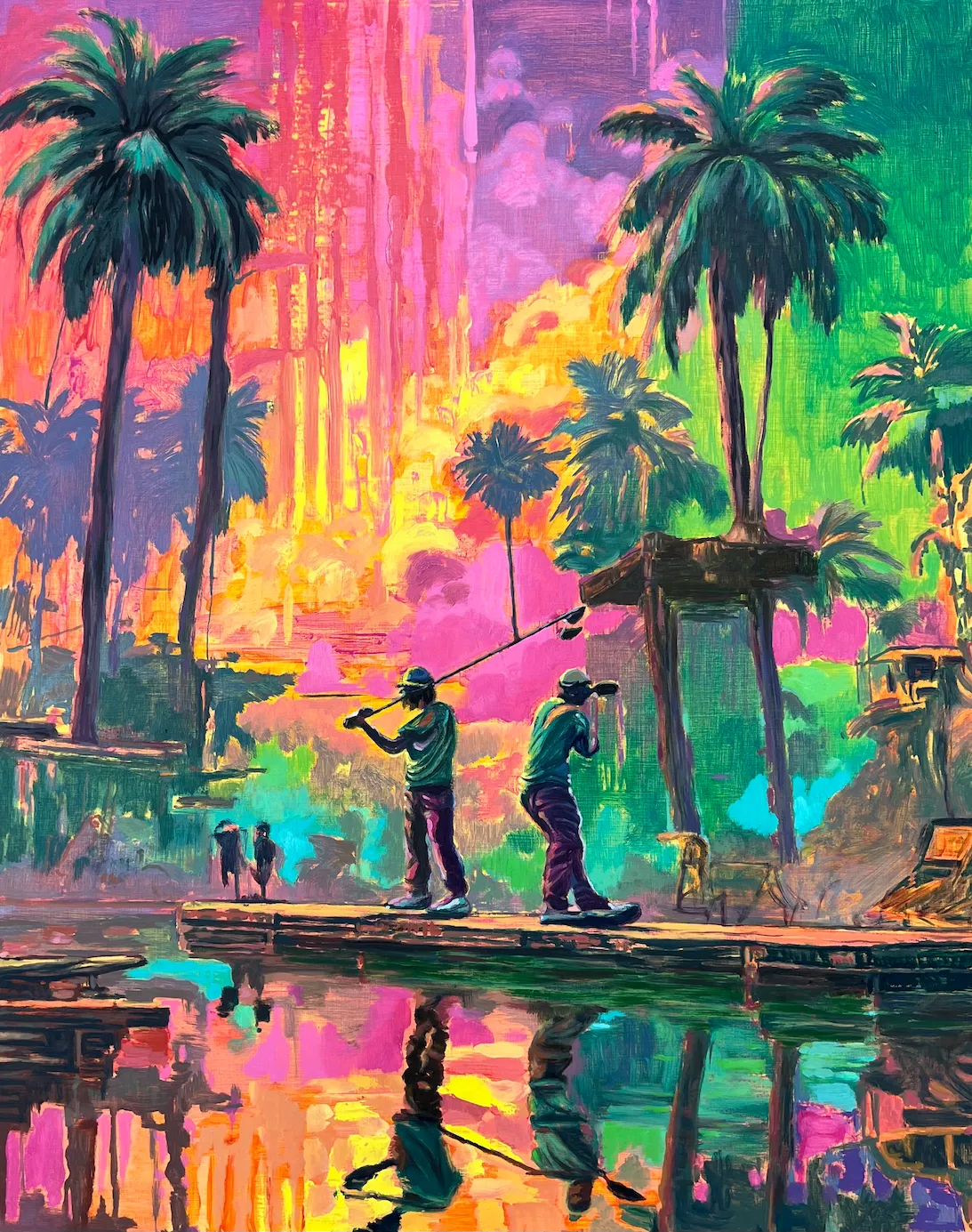
Ed Saye – Echo of Initiation
Ed Saye has been quietly held in our Masters section for some time. He’s one of those artists you look at and think: it’s only a matter of when. The depth is there, the coherence, the unmistakable hand. Serious collectors have noticed. The work has always had gravity, what’s shifting now is the light around him.
Part of the reframe, or rather the restructure, at New Blood Art is about making sure each artist we show receives the focus and attention they deserve. That simply isn’t possible in a sprawling gallery. So this newsletter is an overdue moment for Ed. His palette has deepened. His studio has changed. And what’s emerging now feels undeniable.
I thought of Ed’s paintings this morning, walking early along the coastal path. I love being up before the world begins, but I remembered something else from those hours. It used to happen in Richmond Park too, very early: if you’re the first one out in nature, you’re the one who breaks the cobwebs first. Those near-invisible threads spun overnight, stretched just wide enough to catch a cheekbone. You walk into them without knowing, and suddenly you’re entangled in something both delicate and architectural, something you weren’t meant to disturb.
That’s the feeling I get from Ed’s work. Like you’ve entered a psychic terrain that was still forming, half dream, half echo. It doesn’t shout. It doesn’t explain. It’s there to be stepped into. His subjects are reaching toward myth but falling short. It’s not heroic, not even fully initiatory, just this strange echo of what initiation might have looked like, now refracted through leisurewear, missed putts, and fluorescent cocktails.
The figures in Ed’s work appear to be continuing with certain gestures, postures, or behaviours that might once have been part of a meaningful masculine ritual, golf, drinking together, gathering under a canopy, but now feel emptied out or suspended. The world around them has changed (or ended), and yet these behaviours persist. That psychic lag, the continuation of form after meaning has thinned, is what makes the work so haunting. The ritual itself is now hollowed, unresolved. They’re still inside it, but its power has flickered or shifted.
Not that there’s anything wrong with golf. But if the tree is glowing, the jungle’s burning, and the sky is pink from something unspoken, maybe it’s time to put the club down. The pathos, the psychic static, the suspended state. And the colour, post-apocalyptic, hyper-saturated, neon toxic at times, gives the work a kind of irradiated beauty. Like everything has already been nuked, and still they’re here: teeing off in the ruins, mid-swing, mid-sentence. There’s no catharsis, just continuation. They haven’t left the ritual, though something essential has already slipped.
What Ed has achieved, rarely and precisely, is a coming together of serious contemporary painting with something wholly individual, aesthetic, and strange. These are works you can love immediately, and sit with indefinitely. They’re structurally complex, emotionally suggestive, and entirely his own.
He’s not making escapist art. He’s charting the space between collapse and meaning, the part where you’re still holding the glass, still squinting into the jungle light, still waiting for something to begin.