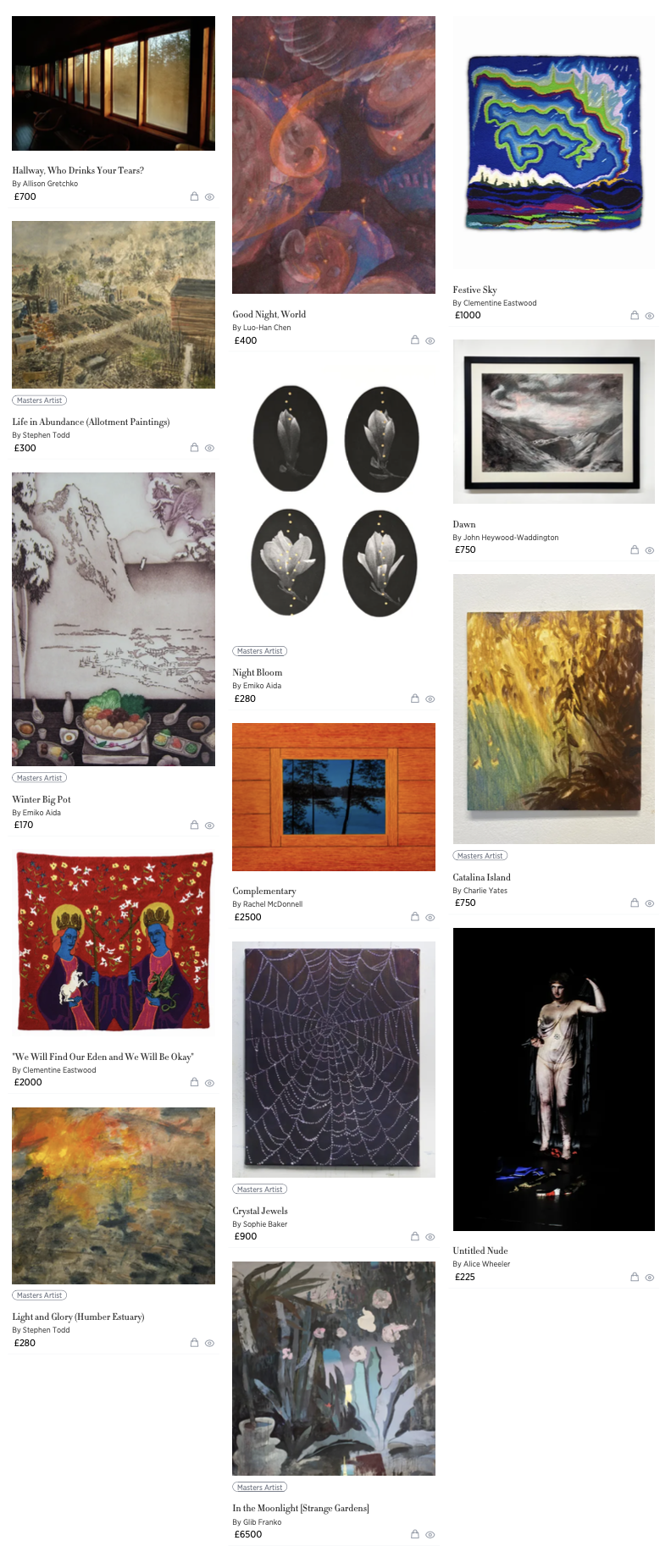
Curated by Artists #9
With Artist Curator Emma Phillips
“Emma Phillips paints the pause between worlds, but in HD.”
– Sarah Ryan, Founder of New Blood Art
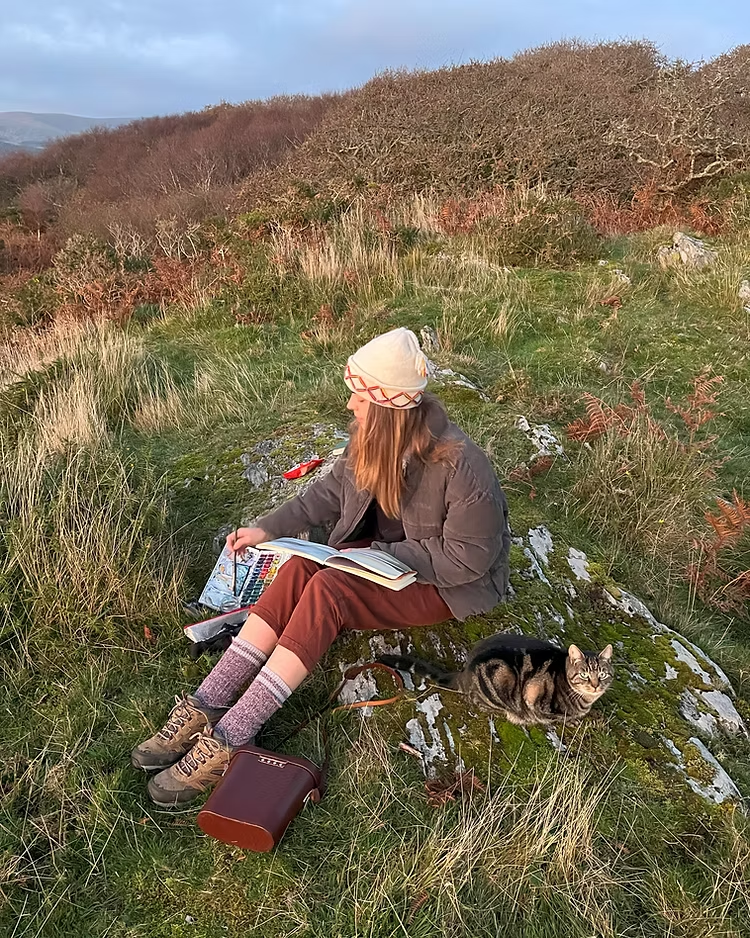
From Nicola Wiltshire’s Curated by Artists series, on today, the shortest day, we are delighted to bring you this interview with New Blood Artist Emma Phillips, a painter whose work explores ritual, folklore, and landscape.
Emma graduated from UAL Wimbledon in 2021 and has already held her first solo exhibition, alongside participation in numerous group exhibitions. She completed the Mawddach Residency in Wales last year and has had work longlisted for several awards and prizes, including the Trinity Wharf Drawing Prize. We were drawn to her work for the way it explores landscape, the changing seasons, and a quiet yet intricate mode of contemplation.
You can read the full interview below. Emma has also curated a selection of works exploring the theme Winter Solstice. You can view the collection here.

Llyn Llydaw by Emma Phillips Oil on wood panel. 25 x 25 cm £650
NBA: Your work has a strong painterly quality. The colours are intense, yet there is a soft haziness to them. Almost like the images left behind from memories, with a suggestion of scent, temperature and sound somehow intertwined. Considering all this, it’s interesting to see how you achieve a similar atmosphere in your drawings. What keeps you coming back to pencils on paper?
EP: I drew a lot as a kid, but I didn’t really take the medium seriously until my second year at university. I was studying painting at UAL Wimbledon, and when the pandemic began in 2020, the studios closed, and we had to start making work at home instead. I had to move back to my parents’ house for a time, where painting in the freshly carpeted spare bedroom wasn’t an option, so drawing became my primary focus by chance.
My tutor at the time, Dr Zoe Mendelson, is a particular champion of drawing, and showed me its potential as an incredibly rich and important practice in its own right, rather than just a precursor to painting. I subsequently became so obsessed with drawing that I didn’t make another painting until 2024!
Although I’m predominantly painting again now, I still try to keep up a regular drawing practice, as I find it keeps my skill sharp and helps me build up my own visual language. My sketchbooks become little encyclopaedias of collected imagery and ideas to draw inspiration from. Often they’re also diaristic, recording places I’ve been or things I’ve seen or experienced that feel important to commit to paper.
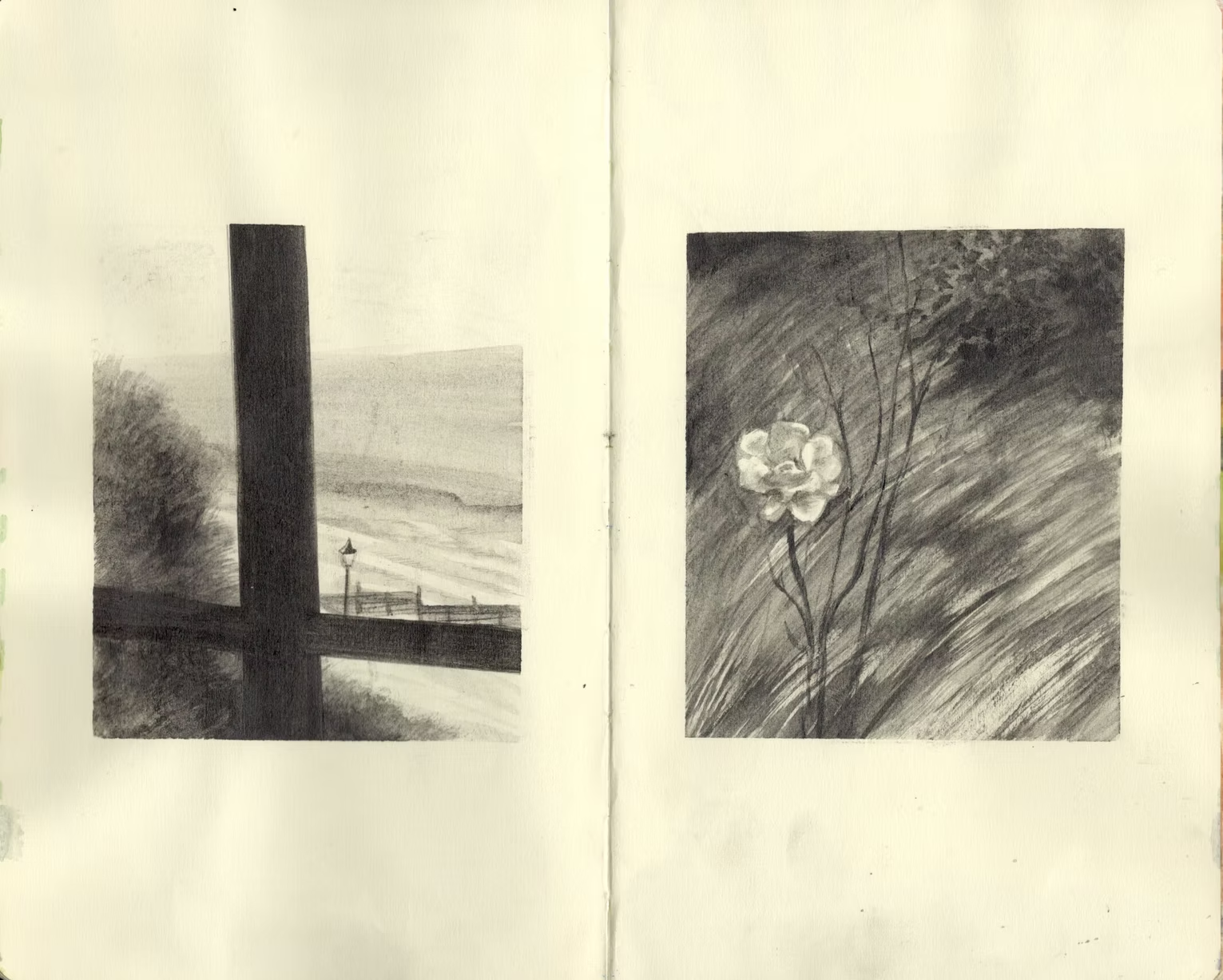
Extract from a sketchbook by Emma Phillips.
NBA: I see you grew up in Stevenage, which is interesting. There is often a clarity and clear communication in the work of artists who live in these places that are on the edge of larger cities. Something about being in the proximity to both countryside and densely populated areas. Liminal spaces. Between extremes. Do you think growing up in Hertfordshire has changed the way you approach your work?
EP: Ironically I think the most interesting thing about Stevenage is its distinct lack of any character. Being one of the first post- war New Towns, it doesn’t have much history, and its gloomy modernist architecture, concrete retail parks and over-abundance of roundabouts doesn’t inspire much pride in its residents. But I think growing up here probably gave me an appreciation for the mundane that has been quite useful artistically. It was the basis for the first series of paintings that I really felt happy with, and whenever I feel stuck with my work, it always feels helpful to return to it for inspiration.
In my very first term of Uni, I had made some half-hearted attempts to make work about social issues, just because it seemed like that’s what you’re supposed to do at art school. Unsurprisingly it was all terrible, ungrounded and fell flat with my tutors. So, I took the ‘write what you know’ approach, went home, and walked around Stevenage with a camera. I photographed places where I used to meet my friends before school, where I had played as a child, or kissed boys as a teenager. I painted them all when I returned to London, and my tutor loved them, and I loved them, because they actually meant something to me, and I think that honesty, and all my bittersweet feelings about leaving the town, came across in the work.
I’ve always found it interesting that 80% of people in the UK live in suburbs, but you rarely encounter suburban scenes in major galleries. Either because there aren’t that many successful artists from boring suburban towns, or people just aren’t interested in recording them. George Shaw has always been one of my favourite artists for making paintings that reflect these places so beautifully.
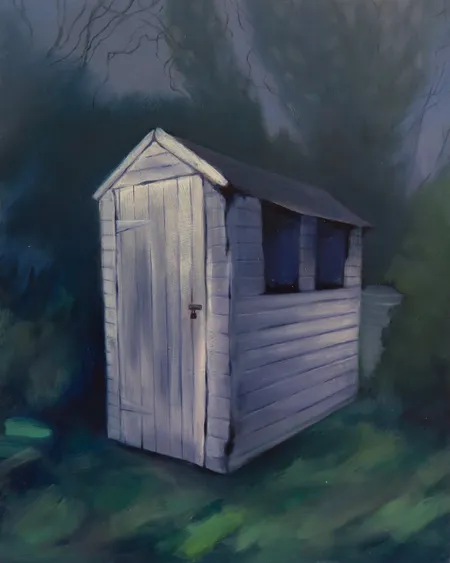
Love Shack by Emma Phillips Oil on wood panel. 24 x 30 cm £500
NBA: There seems to have been a significant shift from your early paintings and drawings, to the ones you are making now. It’s unmistakenly the work of the same artist – the familiar, yet strange, mysterious and otherworldly atmosphere remains. But the recent work seems more honed in on the moment, the story, the essence. Instead of an entire street view, we stepped inside – all the way into a private moment. What happened in these years between 2020 and 2024? Was it a conscious shift, or a natural progression?
EP: I think this is probably a reflection of how my life was changing in those years. Between 2020 – 2024, I moved house 4 times, graduated, hopped between different jobs and of course there was the pandemic. Everything felt so unstable that it was difficult to keep a consistent practice whilst trying to sort my life out. Doing the Autumn Intensive at the Royal Drawing School In 2023 was an important turning point in re-connecting with my practice, and other artists at a time when I needed it. It was challenging and experimental and pushed me out of my comfort zone. Naturally the series of paintings that followed were less concerned with place, and less literal as I became more interested in narrative, symbolism and atmosphere. Looking back, the darkness of those works probably reflected a lot of the turmoil I had been experiencing around that time.
Things became more stable when I got my current job in 2024, and I was lucky enough to go on the Mawddach Residency in Wales. This developed my interest in British folklore which I’m continuing to explore in my work.

Buttercup by Emma Phillips Graphite pencil on watercolour paper. 30 x 42 cm £180
NBA: There is often an element of ritual and ceremony running through your work. Where does this come from?
EP: I think this is probably symptomatic of a growing interest in religion and spirituality among my generation, as a result of a general fatigue with consumer culture and hyper-individualism.
I am not religious or particularly spiritual – I became interested in British folklore for its intrinsic connection to the landscape, but I think folk practices offer the same feeling of community and appreciation for a higher power (in this case, the natural world), that religion does, without requiring a prescriptive belief system.
I think it’s important to preserve folk practices, not just from a heritage point of view, but because they help to shape positive attitudes toward our environment, which we need now more than ever, and this is why I’m so keen to bring attention to it in my work.
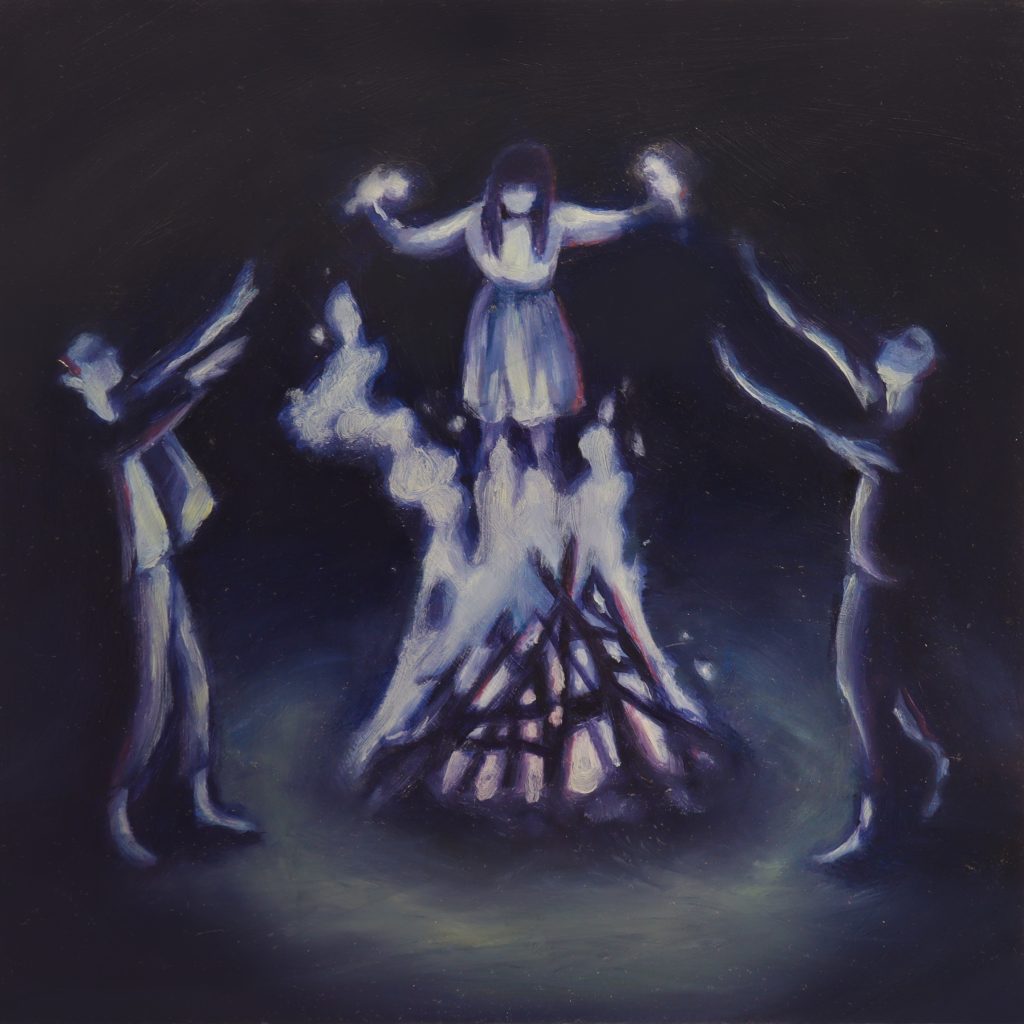
The Big Good Thing by Emma Phillips Oil on board. 20 x 20 cm £400
NBA: Your work is so sensorial and seems to be grounded in experiences. Is where you live important? Or do you find inspiration from other places, like books, films or travelling? Can you imagine an ideal place to live, where you and your work would thrive?
EP: Being a landscape artist in London, I do have to rely on other sources to make the work that I really want to make, but is it the best place to be at the moment for finding work and opportunities in the arts.
I don’t travel as much as I would like, but when I do go away I try to record as much as possible, and as a result have been working off a lot of material from my last two visits to Wales over the past year. I think like most artists, you’re always keeping an eye out for something that might inspire you and I do tend to always find something even in unexpected places. I went to New York for the first time in September and was enchanted by the Birds of the World exhibit at the Natural History Museum, which featured a collection of really beautiful dioramas, exhibiting bird specimens in their natural habitats. I ended up painting one of them when I returned home.
I have also taken inspiration from books and films that I love such as Wuthering Heights, Jan Švankmajer’s iconic 1988 film ‘Alice’, and the 1993 Secret Garden, which was my favourite film as a kid. They all strike a particular mood or aesthetic that I try to bring to my painting.
I have threatened to move to Wales on occasion, and although it isn’t the right time now I think I might end up there someday, or at least somewhere in the UK that has plenty of mountains, lakes, and waterfalls to paint.
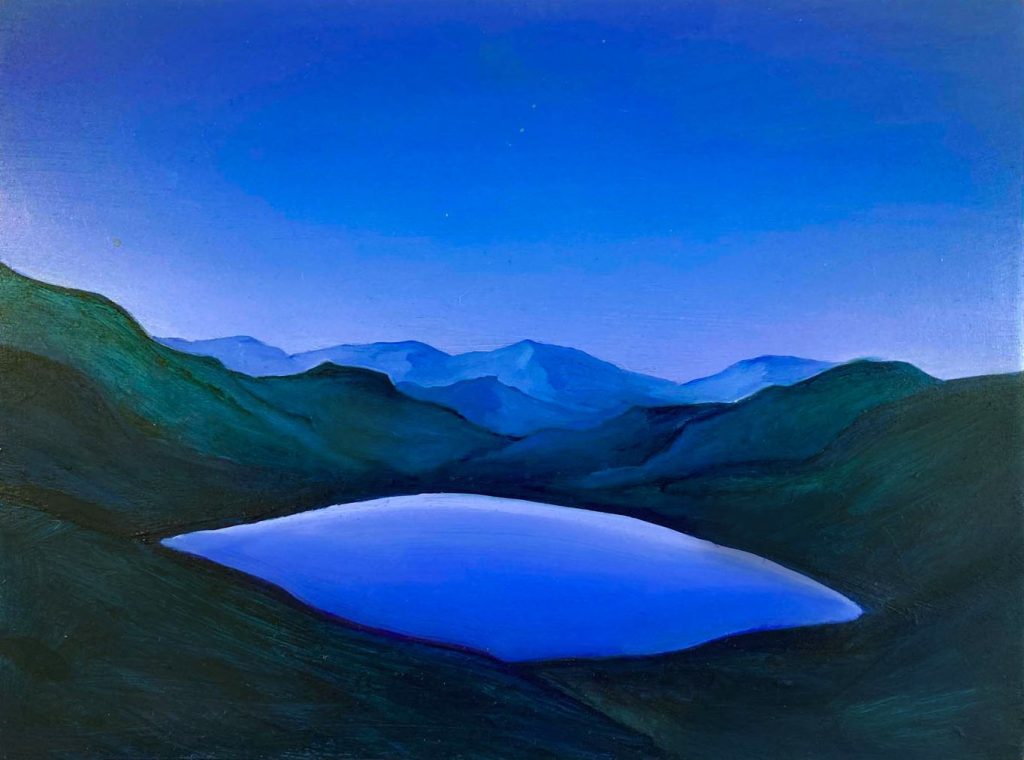
A Thin Place by Emma Phillips Oil on wood. 30 x 23 cm £500
Alongside this interview, Emma Phillips has curated a selection of works. On her inspiration, she writes:
“I chose works that reflected Winter Solstice themes of long nights, ritual, winter, and welcoming back the sun.”
Winter Solstice: With Artist Curator Emma Phillips