Financial Times
Emerging talent on the line
Read the full article online via The Financial Times
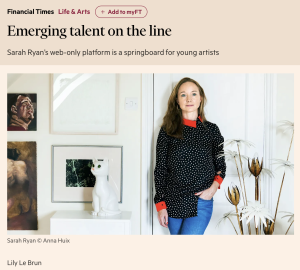
The idea for New Blood Art, an online gallery for emerging artists, seeded itself in Sarah Ryan’s mind while she was at art school in the early 1990s. She knew there was an appetite for genuinely affordable artwork, yet she and her fellow art students were supporting themselves by taking part-time jobs in bars. “All our drawings were going in portfolios under our beds,” she says. “But I couldn’t quite work out how to resolve that disconnect without the overheads of a physical space.”
On the cusp of the millennium, with a world newly online, she realised the internet had become a viable way to help young artists sell work, and New Blood Art was launched in 2004.
Each year Ryan scours art school graduation shows across the UK, and invites artists to show, exclusively, with New Blood Art. Currently there are about 150 names listed on the site, and around 50 new artists join each year. Artists who accept Ryan’s invitation, or make a successful submission to her, upload images of their work to the website along with a brief profile. Customers buy art directly from the website, and New Blood Art takes a 40 per cent commission. Prices are set at between £175 and several thousand pounds. The average sale price is around £400.
A web-only sales platform allows the prices of the artworks to be kept low, for work to be available year-round and for more artists to be shown than would be possible in a normal commercial gallery. But, Ryan says, with disarming honesty, “I wasn’t at all sure if people would buy online, because, in truth, I didn’t feel like I would have done. There’s something about seeing work in the flesh, there’s some kind of energy about it that doesn’t translate online. So I’ve been consistently surprised by the fact that people do.”
The value of the online art market has risen from $1.57bn in 2013 to an estimated $2.64bn in 2014, according to the Hiscox Online Art Trade Report 2015. But although the internet is becoming an increasingly acceptable venue for showing, buying and selling art, Ryan continues to recognise the limitations of an online-only platform. In May this year she launched a Kickstarter campaign — supported by many of her artists — to fund a space that would act as a gallery, a studio and a project space for workshops and talks. It failed to reach its target, which she blames on a number of reasons including a lack of clarity in what they were offering and a failure to reach a wide enough audience.
The campaign was a response to the paradox that has arisen over the decade that the site has been active. What happens when budding artists mature? Many go on to be represented by more established galleries, who can support higher prices and regular exhibitions. “Of course if an artist secures gallery representation, and we have helped them gain wider recognition and set them on a meaningful career path, then that’s great.” Ryan says. “Though it does also mean that we are putting in the legwork but losing the artists just at the time when there’s more scope for long-term revenue.” – Read the full article online via The Financial Times
Sarah Ryan Financial Times