New Blood Art: The Origin Story
Part One
A story by Sarah Ryan
Like most real beginnings, it started before it started. New Blood Art was incorporated in 2004, yes. But the seed – the real beginning – was earlier. Before the website. Before the gallery. Before I even knew what I was trying to build.
I hesitate to call myself an artist – because I haven’t yet fully inhabited my own practice. Not yet. I’ve followed ideas, made things, built from scratch. But the word artist still feels slightly ahead of me – like something I’m growing toward. I’m happy to say that New Blood Art came out of that same place. And it still does.
School never quite made sense to me. Except for the art room. That part landed, making things, noticing things, following a thread without having to explain where it came from. I was good at it, and it held me. So when the time came, art was the only thing that did make sense.
Before starting my degree, I took a year out to travel – adventurous, impulsive, probably both. The ADHD diagnosis came much later. It helped explain a few things.
After A levels I worked in the local supermarket to fund a flight and bought a ticket with my friend Rebecca to travel to Africa – to Tanzania. It was the cheapest flight we could find – with Aeroflot – which meant an itinerary that looked like it had been assembled by someone throwing darts at a map. London, Moscow, Cyprus, Yemen, the Seychelles, Nairobi.
It was a discombobulated trip – we seemed to have breakfast about five times in a row. New passengers kept getting on and off, time zones folded over each other, and someone was always offering eggs. Often just slamming a hard-boiled one at you, to be honest – it was a bit aggressive. And this was still the era when you could smoke on a flight – there was a lot of smoking going on. Including during takeoff.
And when we landed in Yemen, I missed the announcement about changing planes, left my passport in the seat-back pocket. I wasn’t ignoring anything – was just very, very busy noticing other things. Like the man in the transit lounge chasing a rat with his sandal – he caught it – and something in me just quietly checked out. Even now, the smell of floor polish in hot countries does something strange to my nervous system.
How we got to Tanzania and what happened from there is a whole other story – there were lions and I was almost sold. Twice. For thirty cows. It sounds funnier than it was. Honestly, a couple of times I thought we were going to die. Another friend we met out there ended up in prison – we took some wine round to a local ambassador to try and get him released. It’s one of those stories that’s so unbelievable in the retelling, nobody ever believes you. So I’ll stop there.
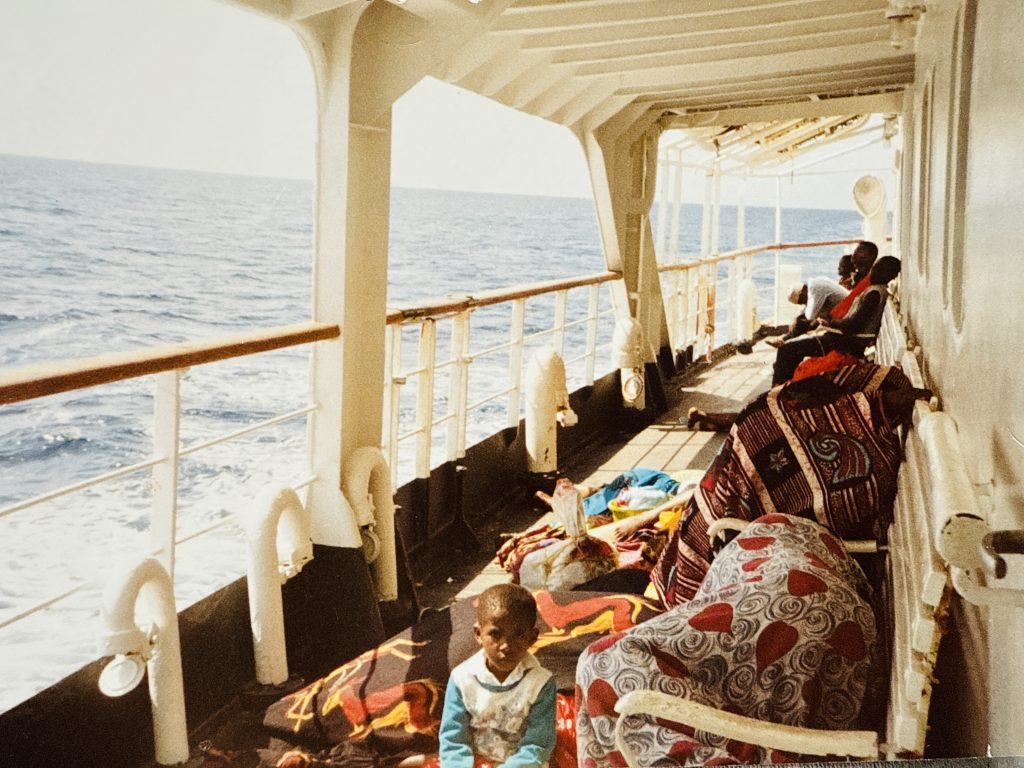
This wasn’t part of the plan. (We weren’t meant to be on this boat.) A cargo vessel from Dar-es-Salaam to Mozambique. 48 hours. No stops.
That year was pivotal. I wouldn’t have called it synchronicity at the time – though would now – and looking back, it’s hard not to see the thread. Going to Tanzania opened something in me. It gave me my first experience of Africa and it also gave me something else. A way of moving through the world. That quiet internal yes: I’ll do that thing. It opened the possibilities of the world to me – not just geographically, but in every other way too. That experience became a love of Africa. And so when Botswana came up, four years later – I said yes.
I left London in 1998, when very few people even had a mobile phone. And came back in early 2000, after two years in the desert, and stood on the platform at Earl’s Court watching – the world had a phone next to their face. Everyone was online, connected, and somewhere else. I hadn’t seen the shift happen, had landed back in another world and it hit me – like you’re hit when you step off a plane into a wall of heat.
The timing of it all mattered. And, on reflection, New Blood Art – like most important things – actually started before it started.
Part 2
London, 1994
That glimpse ahead was real. But I was still nineteen – just back from Tanzania, not yet at university – when I came back to London and fell in love with a magnetic boy (who looked like he belonged somewhere else entirely), We’d known each other since sixth form – adjacent schools. He wasn’t like anyone else I knew.. Another free spirit, both of us somehow dropped into a suburban world we didn’t quite fit – and we fell into summer together like it was a spell.
My fine art degree started at Aberystwyth, (probably the best place I could get into without a foundation degree) and he was studying law at King’s College London.
He came to visit me during freshers week. And that was sort of that. He arrived, and somehow I didn’t… we were back and forth, between his place and mine. And then a few months into term when I was meant to be getting the train back to Aberystwyth, something in me couldn’t leave. I found myself going up and down in the lift at Hampstead Station – street level to basement, basement to street – again and again. Maybe it was restlessness. Maybe it was love (maybe it was undiagnosed ADHD). Maybe it was all three. I didn’t go. I stayed in London – and walked my art portfolio around the art colleges to try and get a place half way through the first term – knocking on art tutors’ doors. Ian Robertson opened his – at London Guildhall University, in Aldgate East. I had a whole pitch ready… He looked at the work and said, “Yep, that’s fine.”
The magnetic boy moved me into his tiny halls of residence room – with him, and his hamster. (Yes, he had a hamster in his halls room.) I wasn’t supposed to be there, and neither was the hamster. We used to half-heartedly rearrange the hamster cage into a coffee table in case a cleaner walked past and spotted it. We were always slightly braced for someone to say, “You can’t have that hamster in here”, completely sidestepping the larger issue that I wasn’t supposed to be there either.
We were freestyling love.. There was no plan. We were just in it’- alive, and following a thread. (Which, looking back, is more or less how I started and ran the gallery too.) It was a kind of quietly absurd, low-stakes high-stakes setup. Magical in its way.
After halls, we moved into a house near Clapton. The estate agent had driven us in through Stoke Newington, which looked easier to explain. We didn’t realise where we were until we’d moved in. It was Clapton – East London – culturally rich, a bit of everything. Not somewhere we’d imagined, but somehow, there we were. The others in the house were King’s students – not artists. Law, pharmacy, English, geography. I was the only one coming home with charcoal on my hands and life drawings under my arm. I gave some away. Sold a couple. It didn’t feel like anything unusual. I wasn’t thinking about it. I was just living – between two completely different worlds.
And so, the broad strokes of an idea started to take shape… I’d go back to the studio and see my friends at college making these incredible drawings and paintings and then packing up to go and work in a pub for minimum wage. Or, like me, folding jumpers at the Gap on the King’s Road. I started to notice the gap. I was literally working and living in it. There wasn’t, then, a way to sell work like ours.
Posters were everywhere, of course. Reproductions. But if you wanted something original, something real, there was nowhere to go – unless you had gallery money, or knew someone. There were young artists and there were people who wanted to buy their work. But no mechanism in between – that was the gap. And also, I suppose, the beginning – as I started to wonder – how do we do this? And this quiet, insistent, not fully formed idea – kept circling… though every way I looked at it, it seemed to fall down on the same thing: if you’re selling a life drawing from an art student, you can’t be paying high street rent (actually you can’t be paying any rent…). That was probably my first brush with anything resembling fiscal awareness.. I didn’t realise that’s what it was at the time. I just knew the numbers didn’t add up.
There weren’t really other models. The railings at Bayswater were there – paintings lined up outside Hyde Park – but it always felt more like spectacle than curation. The work didn’t feel held.
And then there was Hyper Hyper, on High Street Kensington. That wasn’t about art, but it stirred something. A kind of layered, independent energy. Small spaces. Individual visions. A collective made up of fragments. I think, if I could’ve done something like that for art, I would have. It probably wouldn’t have worked then – but it would now. Something like an open-plan gallery-meets-studio space. Somewhere permanent but light, where artists could be visible without being absorbed – that’s still in there somewhere I think, yet to manifest.
Back to the story.. I had followed my heart. And that chapter closed.
The love affair with the magnetic boy and the hamster ended in our final year – we were in India at the time. He went back to London, I stayed out and spent a couple of months during monsoon season, in one of those wildly long university holidays… living in a whitewashed room with a bed and a large balcony surrounded by tall palm fronds and a constant downpour, waiting out the monsoon (and the heartbreak) – a long exhale in the rain.
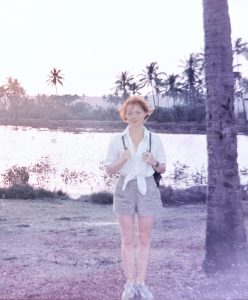
Goa, 1997. Palm trees. A white shirt. A pause in the rain.

Mysore Zoo Animal Hospital
I’ve come to learn that challenges – when you let them – pull you back to your centre.
Stay with the pain long enough, and you are changed.
Part 3
Cambridge, 1997 – 1998
After India, I didn’t want to go back – I wanted to go forward. Somewhere new. To cross into a new space. Cambridge offered that – a place at Homerton College – a postgraduate year in art education. On my first day, I met another Sarah. We ended up sharing the year – our names, our rooms, our clothes and our weekends.
“Sarah…?” “Yes, Sarah?”
We seemed to give each other permission to be silly and shared a kind of lightness that made the rest possible. There was a quiet sense of being in it together. I had needed that – it was the perfect antidote to the year before. Teacher training is a world of its own. One moment you’re writing about educational theory, the next you’re trying to motivate a room full of teenagers who are five minutes younger than you and twice as confident.
As an artist, it was a new kind of performance – managing energy, leading a space, staying soft while trying to keep some order. And the art room? Endless possibility. Endless mess. A space for brilliance, rebellion, and the occasional sculpture you hoped no one in senior leadership would notice. We learned the rhythm of that full-on year together – hold it in, let it out. Repeat. Staying afloat sometimes meant saying “Erm, excuse me Year 9s!” forty times a day – trying to maintain some version of authority while secretly wondering if you were pleading for help.. We kept the lightness alive wherever we could.
Like at the salsa class. We arrived hopeful, but the room was mostly men with unusual footwork and intense eye contact, so we did the only sensible thing and partnered with each other. By the time we made it to Pizza Express we were a little overwrought – sweaty, adrenalised, trying to behave… We were seated at one of those tiny marble tables, with a paper menu that looked sturdier than it was.
We ordered two large glasses of red wine and a Veneziana. When Sarah set her glass down, she didn’t realise the menu was hanging off the edge. The weight tipped, the menu flipped, and she caught it – in one of those beautifully fast, reflexive sportswoman moves – but by then the wine had already become a red arc in the air. It landed, quite precisely, on a woman in a white suit at the next table.
Sarah immediately went into dry-cleaning mode – polite, mortified, willing to pay for everything. We wanted to leave, of course we did, but that would’ve been too rude. We’d already ruined her suit. We ate most of our pizza and didn’t look at each other for the rest of the meal. It was almost unbearable. We left, nodding our apologies, whilst edging backwards toward the door.
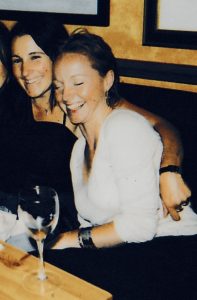
With Sarah, Cambridge, 1998
Part 4
The British Council were advertising teaching posts in Botswana. Naturally I applied. The training had been, in a way, a passport for travel – a way back to Africa. I was offered Head of Art at a government CJSS. Two-year contract.
My first post was in a village called Tonota. There was a short internal flight from Gaborone to Francistown. I popped to the loo – it was full of watermelons. Floor to ceiling. I closed the door again, gently, and went back to my seat.
There were only a handful of us on the minibus from the airport – remote postings. One by one, they were dropped into the dust. Then it was just me and one other woman. She was going even further. We’d left the road by then and were deep in the bush. The driver stopped. “This is you,” he said. I held onto her arm, lightly. “I think I’ve changed my mind,” I said. She smiled. I did not get out with enthusiasm. There were goats. (There were always goats. I was always trying to hide the goat in my garden, in case someone noticed it was a good one. If you’ve got a good goat, people start thinking about a celebration. And a celebration means the goat.)
Jetlagged, unsure, holding in the need for the loo, and arriving into something completely other. By the time I reached the school, I wasn’t sure what I needed most. Mma Mazingwa – the headteacher – looked up, unimpressed. She was sucking on a chicken foot. “Mma Ryan, we’ve been expecting you.” The electricity was sporadic. The nearest road was a forty-minute walk. I asked for a transfer immediately, with the calmness of someone ordering tea.
Yet. Alone, unplugged, and in a wild place, far from anything familiar – something in me earthed, adjusted, and settled into the strangeness – like an animal folding into the landscape, no longer startled. I slept under a white mosquito net with a can of Doom and a half-dead torch. It was oddly grounding. Something in me began to find its shape there.
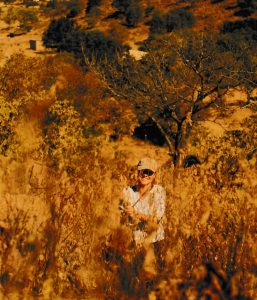
Botswana 1999

Marulamantsi CJSS, Tonota…


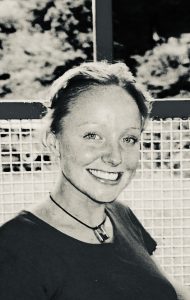
Part 5
London 2000
Fast forward two years and I’m back from Botswana, staying with my parents in London and supply teaching – in that quiet space between what was and what’s next.
One afternoon my dad took me to PC World and under the store’s bright lights, stacked with beige machines and boxed-up function, we found the original Apple iMac. Not the bright, candy-coloured ones. The graphite one – looking like a piece of sculpture – translucent, smoky, storm-glass grey. It didn’t belong there. But it was there.
Honestly, it felt a bit religious.
There had been something about that moment in PC World. I knew it, even then. It carried something. A presence, a parting, a beginning.
I set it up in their dining room. This wasn’t the house I’d grown up in – my parents had downsized after I finished university – but they’d done something quietly sweet and fitted a small bathroom into what was now my room for me to return to – which gave me a bit of self-containment. A soft landing, even if it was only a pitstop.
That smoky quartz Time Machine became more than a computer. It pulled me in, and something began. Photoshop. The early internet. And that idea – the one that had been circling quietly since art college, faithfully orbiting from a distance. Late nights. Soft light.
A spell reactivating itself.
It was there again, the idea that never quite fitted..
Until now.
That smoky, translucent object held something like a message. Almost prophetic. Two years later, and my dad would be gone. And not long after that, I’d start an internet company on that strange, sculptural piece we’d chosen together – part computer, part storm-lit oracle.
Just me and my smoky quartz Time Machine. It was pioneering – it was tiny, instinctive, accidental almost. And still, one of the first.
And.. I’m not sure that I can explain this.. (or if I even need to) – but years later I was in Paris, wandering through the Pompidou, when something quietly extraordinary happened.
There it was. My iMac. The smoky quartz one I’d bought with my dad in PC World. Now behind glass, in a display cabinet – a piece of art. I stood there thinking – sorry, what is my computer doing here?
Who let it in?
The object I’d started an online art gallery on – now an exhibit at the Pompidou… I had to do a small double take. (Possibly a triple.) Thankfully I wasn’t holding a coffee. I saw the word: icon. It was part of a design icon exhibition. And for a moment, that word and a timeline all aligned – beginnings, endings, prophecy, presence, permanence – the non-linear nature of time folding in on itself.
Standing there in Paris, faced with this strange, exact object from my past, something important and unseen acknowledged me. It was as if life itself – or my dad, perhaps – was saying: I see what you did with the machine we bought that day together, in the space between worlds – you put a gallery in it. 🙃
In PC World. It had started before it started.
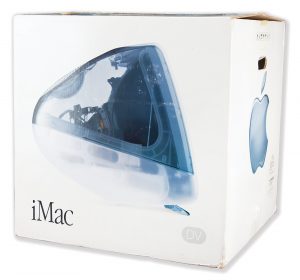
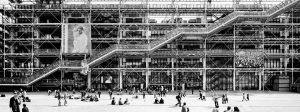
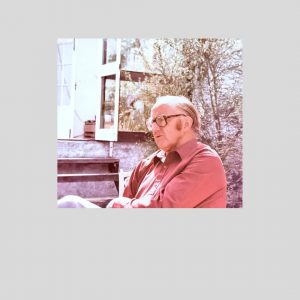
My dad. He saw it too
& if I needed another sign.. You won’t believe it – but I chose a grey for the background of the Instagram caption. Storm grey. Something that felt like dusk or memory. I went to check the hex code. It was #DADADA. The colour of the caption. The ghost tone beneath the text. The one who saw it too. You can’t make it up. But then again – maybe that’s the point. That’s the oracle. Right there.
And then the word stuck: hex. It means a spell, something cast. But in design, it’s also a colour code. This one – #DADADA – sits between memory and fog. It’s not coincidence. It’s language folding in on itself. Hex as omen, hex as tone. Both kinds are real.
Part 6
I found a job teaching art at a boys’ public school in Ealing. A Catholic school and a weirdly relevant yet emotionally irrelevant landmark that vicariously punctuated my life. My brother had gone there briefly. The boy with the hamster had gone there. The man I would later live with, had gone there. And when I and three other fifteen-year-old girls thought we’d seen a ghost on a camping trip, we went there – hoping a priest could help us work out what had happened. (But that’s another story.) After being there just a little while, a few months, I knew it wasn’t the right place for me though, so I left.
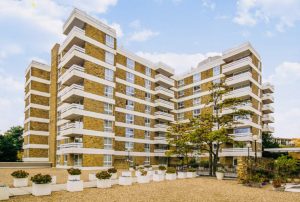
Was running late for a yoga class at the health club one summer evening, so took the lift. It jolted once, then stopped between floors. No phone, no watch, no sense of time. There was a red alarm button, but it seemed designed for another kind of person – someone ready to make a very loud very public announcement (and I was just going to yoga..).
I thought… someone will need the lift soon… won’t they? So I waited. The light flickered. The evening folded itself into a kind of pocket – in suspension. It didn’t feel dramatic. But too much time had passed… Eventually (90 minutes later) I called out. The fire brigade arrived quickly after that and hoisted me out from between two floors (which seems strangely symbolic) cheerful and efficient, like it was nothing unusual.
My elderly neighbour knocked on the door with a miniature bottle of wine – the kind you’re given on a flight with your meal – pressed it into my hand like it might steady something. I thanked her, shut the door, and opened a larger bottle.
One evening I was out for drinks and someone mentioned they worked at the Royal Ballet School. The way she described it… the location, class sizes, the rhythm. It sounded like somewhere I would be able to breathe.
“I don’t suppose they’re looking for an art teacher?”
She paused, looked unexpectedly surprised and said, “Do you know what, Sarah… I think they’re interviewing for an art teacher tomorrow.”
She sent a message. I went in, and they offered me the job.
And just like that. The door opened. And I walked through it.
White Lodge rose pale out of the deep green of Richmond Park – hidden and sovereign, self-contained, a world of its own. The long tracks led towards it, open, breathing space all around, the trees leaning in close.
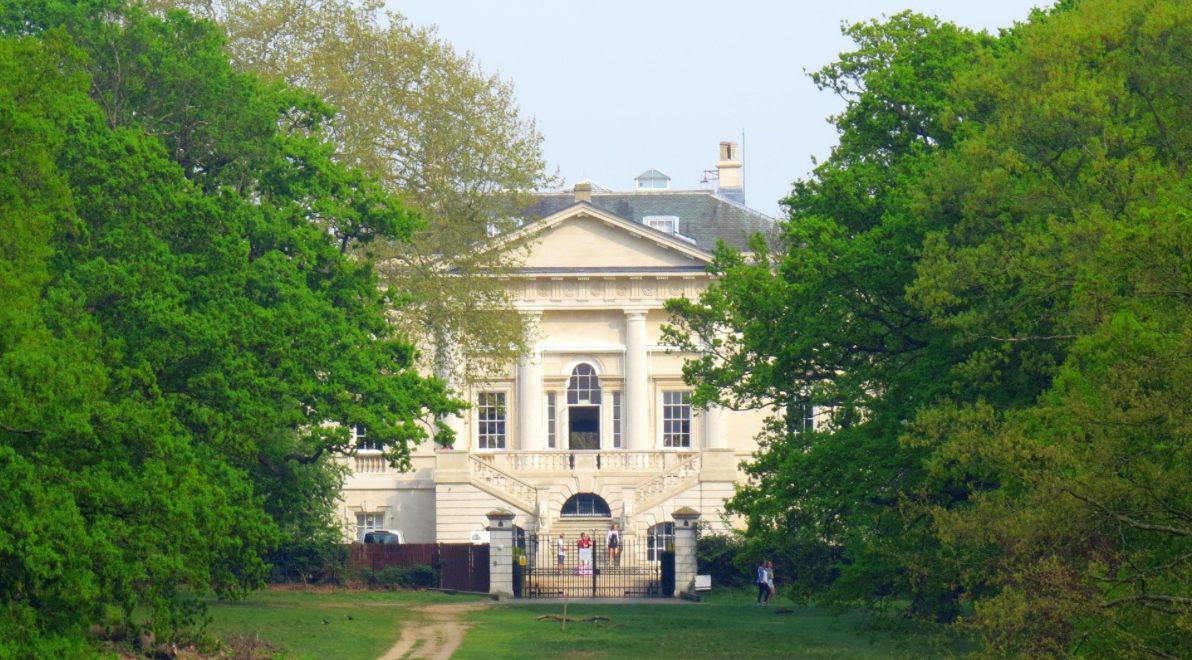
White Lodge, Richmond Park
It wasn’t just a building. It was a kind of secret safe place in the trees, where a different kind of rhythm was possible – quiet, exact, attentive. Each morning I crossed into the park – driving or walking from my flat with the mist rising, stags at the edges of the paths.
Inside, the Ballet School moved in its own time. Stillness. Attention.
Tiny repetitions folding into breath, and into bone. The children stood with a kind of poise I’d never seen – the air seemed to vibrate around them. Breathing, in another key.
The cadence of the place – the repetition, the way the days moved with intention. My nervous system settled again. The school was attuned. Stillness was built into its structure. Attention shaped everything – from posture to the way the day held itself.
Bizarrely, Africa had given me something similar – not the same poise, but a vital, immediate contact with an embodied life force, with nature, and the immediacy of now. Different energies – both with an aliveness and presence that opened the same door, back to self.
This new job and environment arrived at exactly the right moment. At the same time, my dad was coming to the end of his life and I was spending as much time with him as I could – between lessons, in the evenings, and weekends. To have found this new environment – a place that honoured peace, that held steadiness, emotional sensitivity and a connection to nature – made it possible for me to be present.
Part 7
London 2002 – 2004
London in those years had a particular energy – urgent, forward-moving, the city pulling everyone toward its pace whether it suited them or not. I was living between worlds: mornings in Richmond Park with the ballet students, drawing trees, making paintings, quiet conversations in the Nelson Room. And alongside that, something else was gathering itself, quietly and insistently, into being.
The idea had been living inside me for a while. Not yet named, not yet formed, but present – a conviction that the work of emerging artists deserved to exist in the world beyond the gatekeepers, beyond the galleries that decided who mattered and who didn’t. I began giving it voice, speaking it out loud to people around me. And each time I did, it became more real.
It was in those small moments of sharing that the idea moved from interior to exterior. I began quietly researching. Speaking with art tutors, asking whether artists might trust the idea of showing their work online. Meetings began with a web developer in Islington. Between lessons and in the evenings, the platform began to take shape, gathering itself into being. In those small A-level art classes, with students working quietly around me, I’d let my mind orbit the idea and the name it would take.
In 2004, I incorporated the company under the name Rare Online which was quickly changed to New Blood Art. At first, the word rare was about uniqueness, preciousness, rarity. I hadn’t consciously connected rare to undercooked steak – or to anything bloody – but others had, and once it was pointed out, it got me thinking. Surprisingly, blood then became important, in a new, sacred context: blood as life, newness, origin, vitality, not as raw meat, but as a living pulse.
It shifted meaning, deepened, and became the right kind of blood – the real spirit of New Blood Art. The name Rare Online had collapsed the meaning into the wrong imagery: steak, blood, undercooked, not sacred or vital – something slightly grotesque and commercial.
What I was trying to build and to name was alive, vital, new blood, not half-dead meat. The blood in New Blood Art is the blood of life, vitality, origin, the real, living pulse of art being born.
New Blood Art May 4th, 2004.